
Queering 20th Century East Central Europe. Archives-Emotions-Histories
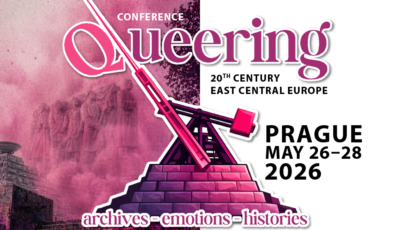
Mezinárodní konference „Queering 20th-Century East Central Europe: Archives – Emotions – Histories“ (Praha, 26.–28. května 2026) představuje klíčové vědecké fórum pro současný výzkum queer dějin ve střední a východní Evropě. Navazuje na předchozí setkání v Marburgu a propojuje etablované i začínající badatelstvo s cílem posunout studium queer minulostí za hranice národních historiografií i lineárních narativů modernity.
Program je vystavěn kolem tří vzájemně provázaných rovin: archivů, emocí a historických procesů. Zaměřuje se na otázky ticha a absence v archivech, afektivní dimenze paměti a identity i proměny regulace sexuality a genderu napříč politickými režimy 20. století. Jednotlivé panely otevírají témata vztahu vědění a moci, medicíny a sexuality, válečných zkušeností i kulturních a každodenních praktik queer života.
Vrchol programu představuje keynote přednáška prof. Ann Cvetkovich (University of Texas at Austin, USA), jedné z nejvlivnějších osobností současných queer studií. Její koncept „archive of feelings“ zásadně proměnil způsoby, jakými lze zkoumat vztah mezi emocemi, pamětí a historií. Ve své přednášce „Feeling My Way through the Archives: A Journey in Queer Method“ nabídne metodologický rámec, který chápe archiv jako afektivní prostor a otevírá nové možnosti historického poznání.
Konference vytváří prostor pro interdisciplinární dialog a směřuje k publikačním výstupům, které přispějí k hlubšímu ukotvení queer historiografie regionu v mezinárodním kontextu.
Termín konání: 26.-28. května 2026
Místo konání: Fakulta humanitních studií UK, Pátkova 2137/5, Praha 8, a Laichter House, Chopinova 4, Praha 2
PROGRAM
TUESDAY, MAY 26, 2026
13:30–14:00 Registration
14:00–14:10
Opening of the Conference
Welcome by the organizers and partner institutions
14:10–15:25 Panel 1: Archives, Recovery, and Queer Life-Writing (Chair: Judit Takács, ELTE Center for Social Sciences, Budapest)
- Barbara Schnalzger (MONAliesA – Feminist Library and Archive, Leipzig): Archiving Queer Lives: The Herstory of the “Lila Archiv” in East Germany
- Paweł Matusz (University of Regensburg): Where Is Zbigniew P.? An Attempt to Reconstruct an Archive of the Host of Queer Balls in Poznań in the 1960s and 1970s
- Dani Carron (European University Institute, Florence): “Deutschland – Einig Hetenland? [Germany – United Hetero-land?]” Queer Engagements with German Reunification, 1989–1991
15:25–15:45 Coffee break
15:45–17:00 Panel 2: Institutions, Expertise, and the Governance of Sexuality (Chair: Anna Dobrowolska, University of Basel)
- Eha Emilia Oras (University of Tallinn): (Not) the Right Kind of Patient: Expertise, Credibility and Sex-Gender Non-Normativity in Interwar Estonian Medicine
- Michał Narożniak (European University Institute, Florence): Wojciech the Hermaphrodite and Leon Wachholz: Early-Modern Lives, Fin-de-Siècle Forensics, and the Emergence of Gender Identity Category
- Flavia Guerrini (University of Innsbruck): What Survives in a Hostile Archive? Recovering Traces of Queer Youth in the Archives of Child and Youth Welfare
17:00–17:30 Coffee break
17:30–19:00
Keynote Lecture
Welcome by Věra Sokolová, the Dean of the Faculty of Humanities, Charles University
Ann Cvetkovich (University of Texas at Austin): Feeling My Way through the Archives: A Journey in Queer Method
WEDNESDAY, MAY 27, 2026
10:00–11:15: Panel 3: Sexology, Psychiatry, and Gender Concepts under Socialism (Chair: Věra Sokolová, Faculty of Humanities, Charles University, Prague)
- Stoyo Tetevenski (Sofia University): “Gender Self-Esteem”: Gender and Gender Identity in Socialist Bulgaria
- Zsófia Anna Veszely (European University Institute): Queer Comrades: Teenage Friendship and Same-Sex Desire in Hungarian Sex Education during the Cold War
- Inxhi Brisku (Institute of Ethnology and Folklore Studies, Bulgarian Academy of Sciences): From Prison to Psychiatry: Queer Lives and Medicalization in Socialist Albania
11:15–11:30 Coffee break
11:30–12:45: Panel 4: War, Occupation, and Queer Lives in Extremis (Chair: Jaromír Mrňka, German Historical Institute Warsaw – Prague Branch)
- Frédéric Stroh (University of Strasbourg, ARCHE): Race and Sexuality under Nazism: The History of Slovenian Homosexuals during the Second World War in a Museum Cellar
- William Ross Jones (University of Oxford): Risk(y) Reading: A Reparative Framework of Risk for the Trans Feminine Past
- Eugenia Seleznova (Central European University): „Straightening“, Silences, Utilizing „Girlhood“: Three Strategies of a Soviet WWII Youth Resistance Member’s Queer Story Public Narrations
12:45–14:00 Lunch break
14:00–15:30: Panel 5: Public Discourses and the Making of Queer Modernities (Chair: Rasa Navickaitė, Vilnius University)
- Barbara Trojanowska (European University Institute, Florence): Heartfelt Friends: Women-Loving Women in Habsburg Galicia’s Public Discourse
- Judit Takács (ELTE Center for Social Sciences, Budapest), Gábor Csiszár (Eötvös Loránd University, Budapest): Queer Intimacies in the Hungarian Popular Press, 1910–1939
- Anna Borgos (Institute of Cognitive Neuroscience and Psychology, HUNREN, Budapest): From Abnormal Sexual Feelings to Rebellious Women: Representations of Women’s Same Sex Attractions in Hungary from the Prewar Years to the State Socialist Period
- Denisa Vídeňská (Brno University of Technology): Caught in the Trap of Representation: Visual Images of Female Homosexuality in Interwar Czechoslovakia
15:30–15:45 Coffee break
15:45–17:00: Panel 6: Cultural Fields, Visuality, and Memory Politics (Chair: Josef Šebek, Faculty of Arts, Charles University, Prague)
- Kata Benedek (Faculty of Humanities, Charles University, Prague): Queer Cultural Capital in State Socialist Cultural Fields. The Hungarian Case / Releasing Emotional Archives: Ethical Reflections on Two Unreleased Queer Documentaries (1981 & 1986) from State-Socialist Hungary
- Maria Vtorushina (European University Viadrina Frankfurt-Oder): Studying Queer Embodiment in Ukrainian Art: Museums and Archives — Allies or Obstacles?
- Anna Dżabagina (University of Warsaw): “Catastrophe of Rampant Homosexuality” – Tracing Lesbian Past in 19th and early 20th Century Polish Egodocuments
17:30–20:00
Queering the East Central European Art: A Cozy Evening at the Laichter House
17:30–18:00
- Štěpán Lars Laichter, Larissa Friedrich (Herder Institute for Historical Research on East Central Europe, Institute of the Leibniz Association, Marburg): Introduction to the Laichter House and the Exhibition with a Special View on Jan Laichter and His Connection to Rainer Maria Rilke
18:00–18:45
- Lisa Rocke & Maximilian Wahlich (The Bauhaus Archive, Berlin): New ideas on figures of the Bauhaus
18:45–19:30
- Gideon Horváth, moderated by Larissa Friedrich: Artist Talk: Discussion with the Contemporary Hungarian Artist
19:30–20:00
- Barbora Lungová (Brno University of Technology): Artist Talk: Queering the Countryside
20:00
- Opening of the Exhibition “Unknown Longings, Hidden Feelings – Concealed Stories in Authoritarian States”
THURSDAY, MAY 28, 2026
10:00–11:15: Panel 7: Activism, Crisis, and Community Knowledge (Chair: Michal Pitoňák, Faculty of Humanities, Charles University, Prague)
- Magda Wlostowska (Leibniz Institute for the History and Culture of Eastern Europe, GWZO Leipzig): Documenting Queer Activists’ Responses to the HIV/AIDS Crisis in Late Socialist and Early Post-Socialist Poland
- Rasa Navickaitė (Vilnius University): Between Sexiness and Monstrosity: Representations of Lesbianism in Post-Soviet Lithuania
- Franko Dota (University of Rijeka): A Letter from Macedonia: The Homophile Voice from the Archives of Yugoslav Queer Lives
11:15–11:30 Coffee break
11:30–13:00: Panel 8: Friendship, Affect, and Queer Memory Across Borders (Chair: Kateřina Kolářová, Faculty of Humanities, Charles University, Prague)
- Georgia-Taygeti Katakou (European University Institute, Florence): Archiving the Greek Left: Friendship, Queerness, and Counter-Communities of Emotion
- Riikka Taavetti (University of Turku): Connections in Interwar Northeastern European Queer History: Martti Laine’s novel Kuilu (1937) in Finnish and Transnational Contexts
- Shaban Darakchi (Institute of Philosophy and Sociology, Bulgarian Academy of Sciences/University of Lund): Love, Secrecy, and State Power: Affective Traces of a Lesbian Relationship in Socialist Bulgaria
- Ioana Zamfir (University of Oxford): Mapping Soviet and Post-Soviet Queer Desire: Reconsidering Identity Formation through Spaces of Affection and Tenderness
13:00–14:00 Lunch break
14:00–15:15: Panel 9: Queer Subjects and Cultural Imaginaries (Chair: Eszter Timár, Central European University, Vienna)
- Mathias Foit (University of Padua): The Male Bride of Breslau, Hungary’s George Sand and the L’Uomo-Donna of Rome: The Queer Diva and Gender Non-Conformity in Belle Époque and Interwar Europe (approximately 1901–1935)
- Eszter Varsa (Central European University / Institute of History, Polish Academy of Sciences): Approaches to the Silenced Queer History of Romani Woman Activist Mária László in 1950s Hungary
- Jennifer Ramme (University of Graz): No Hero’s Tale: Tracing Queerness in Alternative Cultures and Music Scenes of Late State Socialism in Poland
15:15–16:00 Final Discussion and Conference Conclusions – Towards Publications (Chair: Jaromír Mrňka)
16:00 End of the Conference